
Lateral flow strip cutting is one of the most underestimated steps in rapid test manufacturing. A finished cassette can pass visual inspection and still deliver inconsistent results, not because of conjugate chemistry or membrane selection, but because the slitting stage introduced width variation, left microscopic burrs on the membrane edge, or carried trace reagent from the previous run.
This article examines how blade condition, strip width tolerance, airborne dust, and line-change cleaning each affect capillary flow rate and batch consistency, with specific control checkpoints for production supervisors, QC personnel, and factory auditors.

Why Lateral Flow Strip Cutting Determines Flow Rate
The nitrocellulose (NC) membrane inside every lateral flow test strip is a capillary channel. Its flow speed depends on membrane pore size, moisture content, and critically, the physical width and edge integrity of the cut strip. A strip cut 0.3 mm too narrow moves fluid measurably faster than a specification-width strip.
A strip cut too wide produces the opposite effect. In both cases, the time antigen spends in the test and control zones shifts outside the validated window, directly affecting line intensity and whether a densitometer classifies the result as positive, negative, or invalid.
Strip width is a flow-rate variable: A ±0.3 mm deviation in lateral flow strip cutting can shift fluid migration time enough to alter test-line intensity and trigger false-invalid readings at end-of-line QC.
At Neo Nostics, our standard strip width tolerance is ±0.1 mm. We hold intra-batch and inter-batch precision (CV) to ≤15% across all product lines. Meeting those targets starts at the slitter, not at the membrane dispenser.
Slitting Blade Condition: The Root Cause Behind Most Edge Defects
Blade wear progresses silently; visual inspection of the blade rarely reveals damage before defects appear in the product. A sharp blade produces a clean, perpendicular cut through the NC membrane, backing card, and laminate simultaneously. A worn blade drags rather than slices, deforming the nitrocellulose fiber network at the strip edge and creating microscopic burrs, raised filaments that extend laterally from the cut face.
Burrs create two problems. First, they restrict the edge-entry path for capillary fluid, producing a localized flow resistance that varies strip-to-strip within the same batch. Second, burr fragments detach during cassette assembly and travel into the test zone, producing non-specific background staining.
In colloidal gold lateral flow assays, Neo Nostics uses a standard particle size of 20–40 nm; gold nanoparticles aggregate around cellulose debris, making contamination immediately visible in the result window.
Blade Inspection Schedule
| Trigger | Method | Pass Criterion | Action on Fail |
| Every 500,000 cuts | 10× loupe on slitter output | No burrs on 30 consecutive strips | Replace blade; quarantine batch |
| Every shift start | First-off width check (3 strips × 3 positions) | Width within ±0.1 mm of nominal | Adjust pressure; re-check 5 strips |
| After any jam or stop | Visual + width measurement | No deformation; width in spec | Full blade inspection before restart |
| Monthly | 40× microscope on blade edge | No chipping or shoulder wear | Replace regardless of cut count |
With a monthly production capacity of 1.5 million tests, Neo Nostics uses a cut-count trigger rather than a calendar schedule, tying blade replacement directly to actual wear.
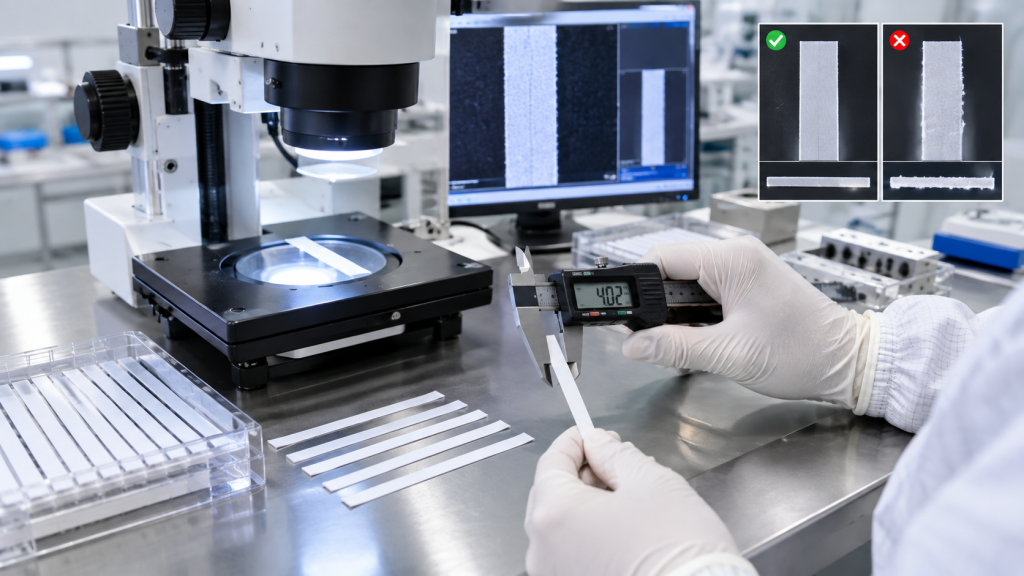
Strip Width Tolerance: Measurement and Rejection Limits
Width measurement requires a calibrated digital caliper or automated vision system, not a manual ruler. The NC membrane compresses under excess clamping force, so measurement technique matters as much as instrument precision.
Measure each strip at three positions: 5 mm from the leading edge, at the geometric center, and 5 mm from the trailing edge. A strip that passes at center but fails at either end indicates blade misalignment or uneven feed tension, two root causes that need different corrective actions.
Rejection limits must derive from the validated flow-rate window, not manufacturing convenience. Document every measurement in the batch production record; width data from the slitting stage is a leading indicator that predicts end-of-line rejection before it occurs.
Skew: Diagonal Cuts and Pad Alignment
Strip skew occurs when the cut face is not perpendicular to the strip’s long axis, preventing the sample pad, conjugate pad, NC membrane, and absorbent pad from sharing a flush interface. The gap this creates functions as a partial flow interrupt.
Skew greater than 2° on a standard 4 mm strip produces a pad overlap error of approximately 0.14 mm, sufficient to generate an inconsistent flow path in 3–5% of strips in an affected batch. The three root causes- worn feed rollers, misaligned guide rails, or a blade contacting the membrane unevenly- all require a physical inspection of the slitter mechanism, not a software adjustment. Add a skew check (45° illuminated microscope stage) to every first-off inspection protocol.
Dust and Particle Control at the Slitter
Lateral flow strip cutting generates membrane dust from the NC cut face and laminate debris from the backing card. Both are electrostatic and adhere to the membrane surface, exactly where assay reagents must bind. Dust settling on the test or control zone partially blocks antibody binding sites, reduces signal intensity, and widens inter-batch CV. When inter-batch CV drifts above the 15% threshold required for CE-marked products, the slitter environment is often the root cause, not a chemistry problem.
Five control measures to implement at the slitting station:
- Install a localized ionized-air blower at the slitter output tray to neutralize static and prevent dust adhesion on cut strip surfaces.
- Enclose the slitting zone with a cleanroom-grade acrylic hood; exhaust through a HEPA filter rated ≥99.97% for particles ≥0.3 µm.
- Monitor particle counts with a handheld counter at shift start; log results in the batch production record.
- Store cut strips in sealed antistatic trays within 10 minutes of slitting to prevent recontamination during transport.
- Wipe guide rails and the output tray with 70% isopropyl alcohol at every shift change; allow full evaporation before restart.
Line-Change Cleaning: Cross-Contamination Between Product Runs
Cross-contamination between product runs is a checkpoint that regulatory examiners and OEM clients consistently flag during IVD facility audits. The slitter presents particular risk because the same blades, guide rails, and output trays handle membrane material from multiple formulations.

Even trace carryover of a previous product’s conjugate onto the NC membrane of the next run produces non-specific signal. This risk grows as Neo Nostics advances multiplex product development targeting simultaneous detection of 2–5 biomarkers on a single test card; cross-contamination potential multiplies with every additional analyte channel.
Line-change cleaning protocol, six checkpoints:
- Blade disassembly: Disassemble the blade assembly completely; clean each blade and spacer with reagent-grade isopropyl alcohol and a lint-free wipe.
- Nitrogen flush: Flush guide rails with compressed nitrogen to clear debris from blade channels before chemical cleaning.
- Swab verification: Swab the output tray surface after cleaning; run the swab through a lateral flow assay for the previous product’s target analyte. A visible test line confirms inadequate cleaning.
- Blank strip run: Run 50 uncoated NC membrane strips through the cleaned slitter; test three in the previous product’s assay before releasing the slitter for the new product run.
- Documentation: Record cleaning agent lot numbers, operator ID, completion time, and swab-test result in the equipment log. EU-market importers request this log during CE-mark surveillance audits.
- Dedicated blade sets: Assign a separate blade set per product family (infectious disease, reproductive hormone, cardiac marker) to eliminate cross-product carryover entirely.
The swab test is not optional: It converts a procedural checklist item into a functional verification, the only way to confirm cleaning eliminated carryover, not just removed visible debris.
QC Specifications Reference
| Parameter | Specification | Monitoring Method |
| Strip width tolerance | Nominal ± 0.1 mm | Calibrated digital caliper, 3 points per strip |
| Intra-batch CV | ≤15% | Flow-rate timing; densitometer line intensity |
| Inter-batch CV | ≤15% | Cross-batch statistical comparison in batch record |
| Burr inspection | Zero burrs on 30 consecutive strips | 10× loupe; 40× microscope monthly |
| Skew | <2° from perpendicular | Illuminated microscope stage at first-off |
| Particle count | Logged per shift; trend-monitored | Handheld counter ≥0.3 µm |
| Line-change verification | Swab assay negative for previous analyte | Swab test + 50 blank strip run |
| Product shelf life | 24 months at room temperature | Stability program per ISO 13485 |
Conclusion
Lateral flow strip cutting controls more downstream variables than most production teams recognize. Blade condition sets the baseline for burr risk. Width tolerance controls capillary flow rate and assay read-time. Skew disrupts pad alignment in ways standard width measurement does not detect. Airborne membrane dust elevates inter-batch CV silently. Inadequate line-change cleaning carries analyte-specific signal from one run into the next.
Managing these variables with documented, measurable control points, not general housekeeping, separates a CE-marked, ISO 13485-certified facility from one that meets regulatory requirements on paper while tolerating preventable batch failures. With a 5-working-day lead time and an MOQ of 1,000 tests, NeoTestKit’s process must run clean from the first step. The slitter is that first step.
Work With Neo Nostics
Neo Nostics (Suzhou) Bioengineering Co., Ltd. has manufactured advanced in vitro diagnostic products since 2015. Our facility holds CE certification and ISO 13485 accreditation, produces 1.5 million tests per month, and exports to more than 80 countries across Europe, Southeast Asia, Africa, and beyond.
- Request Samples: Evaluate strip quality and assay performance before committing to an order.
- Consult Our OEM Solutions: Custom formulations, private-label packaging, MOQ from 1,000 tests.
- Schedule a Factory Audit: Review slitting records, blade logs, QC batch data, and cleaning documentation in person.


